
Deepening our response to the challenge of reconciliation with creation in our lives and institutions
Sharing and unpacking our Jesuit Conference of Asia Pacific Reconciliation with Creation (JCAP RWC) Goal 4: Advocacy
There are many ways to advocate for ecological values within our institutions and communities across JCAP. One important pathway is to focus on policy change grounded in our Jesuit Ecological Way of Proceeding.
We can advocate for renewed practices in our Jesuit communities and institutions—especially in areas not explicitly linked to ecology—so that we live more faithfully the values of Laudato Sí. This advocacy can take place at the level of our Community, Institution, Province, or Conference.
Our JCAP RWC Vision
A world journeying towards ecological conversion and reconciliation with creation, where all people are in communion with one another—especially the poor and the young—with God, and with all of God’s creation.
Our JCAP RWC Mission
Fostering JCAP as an Ignatian community actively collaborating to address the ecological crises of our time through diverse initiatives, capacity building, strategic partnerships, and advocacy that strengthen local communities to live in justice, peace, and harmony with creation.
Our JCAP Environmental Way of Proceeding (2010)
In August 2010, JCAP, together with its lay apostolic partners, developed the Ecology Strategy and Action Plan towards “Reconciliation with Creation,” inspired by the 35th General Congregation’s decree on mission.
In February 2011, the Ecology Task Force of Asia Pacific finalised Our Environmental Way of Proceeding as an overarching document to connect our diverse ecological efforts and ground our shared values. Rooted in Ignatian spirituality, it calls us into a deeper relationship with creation.
- We acknowledge God as Creator of all life and take a quiet moment each day to appreciate this with gratitude.
- As an apostolic body, we reflect and speak about our experiences, discerning our relationship with and responsibility for natural systems.
- We recognise that today’s children inherit this living world, and by finding God in all things, we humbly work alongside young people.
- We reach out in hope to the poor, whose livelihoods and ecological stability are increasingly threatened, and we integrate their concerns into our care for the web of life.
- We support good actions in contemporary culture and explore needed alternatives with discernment, partnering with others to broaden our capacity to transform environmental attitudes and relationships.
- We seek the greater good, discovering how people can work with the gifts of creation. We live life as a mission—to heal and to share the fullness of life.
- We accept the challenge of living sustainably in the world.
Australian Jesuit Social Services (JSS): Developing an Environmental Way of Proceeding
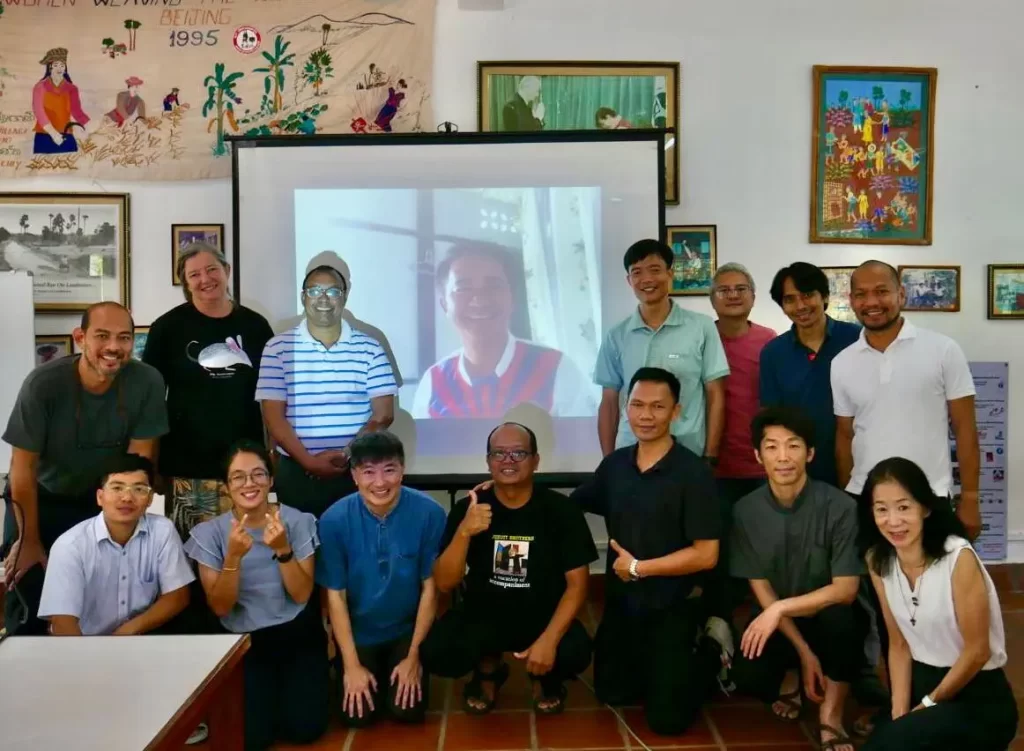
Julie Edwards from Australia shared how Jesuit Social Services developed its ecological justice framework. She described three interconnected domains—Human Spirit, Practice Framework, and Business Processes—and how they shape every decision the organisation makes.
This reminds us that an Environmental Way of Proceeding is not merely a document—it is a way of being.
Ecological Justice at Jesuit Social Services
JSS built its ecological approach on the original Way of Proceeding, recognising three interconnected domains essential to all organisational operations:
- Human Spirit – Exploring fundamental anthropological and spiritual questions about what it means to be human and the conditions that allow people to thrive in healthy relationships. This involves discerning who we are, who others are, and the relational context we share.
- Practice Framework – Cultivating a relational way of being and acting that embodies ecological justice. This includes promoting ecological awareness across practice areas such as justice and crime prevention, settlement and community building, mental health and wellbeing, and education, training, and employment.
- Business Processes – Committing to environmentally sustainable business practices. This includes discerning how financial and material resources can support, rather than undermine, efforts to build a just society.
 Creating Our Environmental Way of Proceeding Today
How do we shape an Environmental Way of Proceeding that is alive, practical, and transformative for our Community, Institution, Province, or Conference?
Advocacy begins at home. Policy change begins with our own Way of Proceeding. It might look like:
- A Province adopting sustainable procurement
- A School integrating ecological spirituality into its curriculum
- A Parish reducing waste and modelling renewable energy
- A Community choosing to live simply, joyfully, and gratefully
Our Environmental Way of Proceeding is not something we craft once. It is something we choose every day—in silence, in community, in advocacy, in partnership, in how we live, how we work, and how we hope.
We are not only responding to an ecological crisis. We are responding to God’s invitation to reconcile with creation. This requires courage, imagination, and love.
What is your Environmental Way of Proceeding?