
The Core Group of the Jesuit Conference of Asia Pacific (JCAP) Social Apostolate met over four days in Bendum, the Philippines—on the ancestral lands of the Pulangiyēn people, where the relationship of the culture with the landscape was very evident in how the natural spring water is maintained by the community through forest management (integral ecology).
We had chosen to meet at Bendum because we wanted to deepen our understanding of integral ecology and to do that in a setting where this is the fabric and purpose of everyday life—not as a series of ‘environmental projects’ but as sustainable living.
This year, being the 10th anniversary of Laudato Si’, along with the upcoming COP 30 meeting in November, further prompted us to focus on ‘the cry of the earth’ and ‘the cry of the poor’ and to build our knowledge of how they intersect and our capacity to respond to them in an integrated way.
Fr Pedro Walpole SJ was our host, along with staff from the Environmental Science for Social Change (ESSC) and members of the local community. Together, they run the Apu Palamguwan Cultural Education Center, where the mother tongue is the initial language of instruction. We were guests at their Teachers Day, and it was moving to see the students’ appreciation of their teachers. Beyond the K-12 school, there is an online network of learning for people seeking higher education.
The Core Group comprises Fr Fernando Aspiroz SJ from the Chinese Province, Fr Pedro Walpole SJ and Sylvia Miclat from the Philippines, Fr Jun Nakai SJ from Japan and convenor of the Migrant and Refugee Network, Fr Gabby Lamug-Nañawa SJ from the Philippines and convenor of the Ecology Network, Fr Paul Tu Ja SJ from Myanmar (who sent his apologies for missing the meeting), and myself from Australia as the conference Secretary for Social Ministries.
The four-day meeting allowed us to connect as friends sharing the same mission. Each day we spent time in nature, with members of the local community, and in conversation—all of this punctuated by regular times of prayer and reflection, sharing food, and concluding with Mass each evening.
We drew on the Ignatian Pedagogical Paradigm to structure our days. On the first day we looked at our Context—at the global, conference, and various local settings we live and work in. This review was enriched by meeting online with Fr Roberto Jaramillo SJ, Director of the Social Justice and Ecology Secretariat (SJES) based in Rome, and his Advocacy Coordinator, Daniela Alba.
We met with Ria Limjap and Vanessa Gorra from the JCAP communications team. They took us through the newly developed website for the JCAP social apostolate, a microsite of the broader JCAP website, and we talked through plans for strengthening communication with and about the social apostolate–both internally and externally–as a way, not only of sharing information, but of affirming the central purpose of the Society of Jesus in its mission of justice and reconciliation and encouraging and inspiring us all to this shared purpose.
We then spent time sharing Experience, of our various networks and works and of the social apostolate more broadly. This fed into a day of Reflection where we had spiritual conversation about what was emerging from our Context and Experience, as a basis for discerning our shared Action for the social apostolate.
In articulating our understanding of this and spelling out a way forward, we returned to the meeting of the social apostolate held in Indonesia last year to review what had emerged there and to incorporate important aspects of that process.
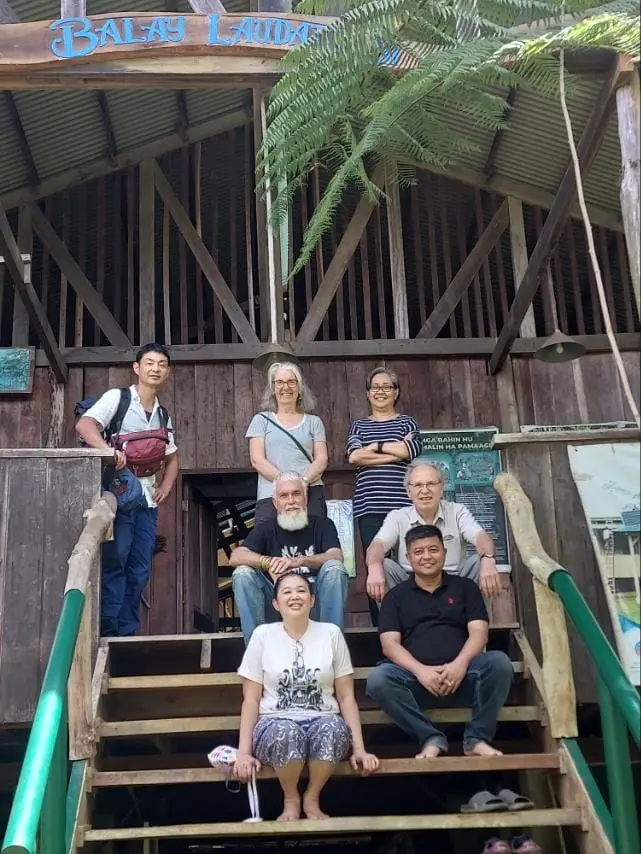
JCAP Social Apostolate Core Group
The following outlines the fruit of our meeting.
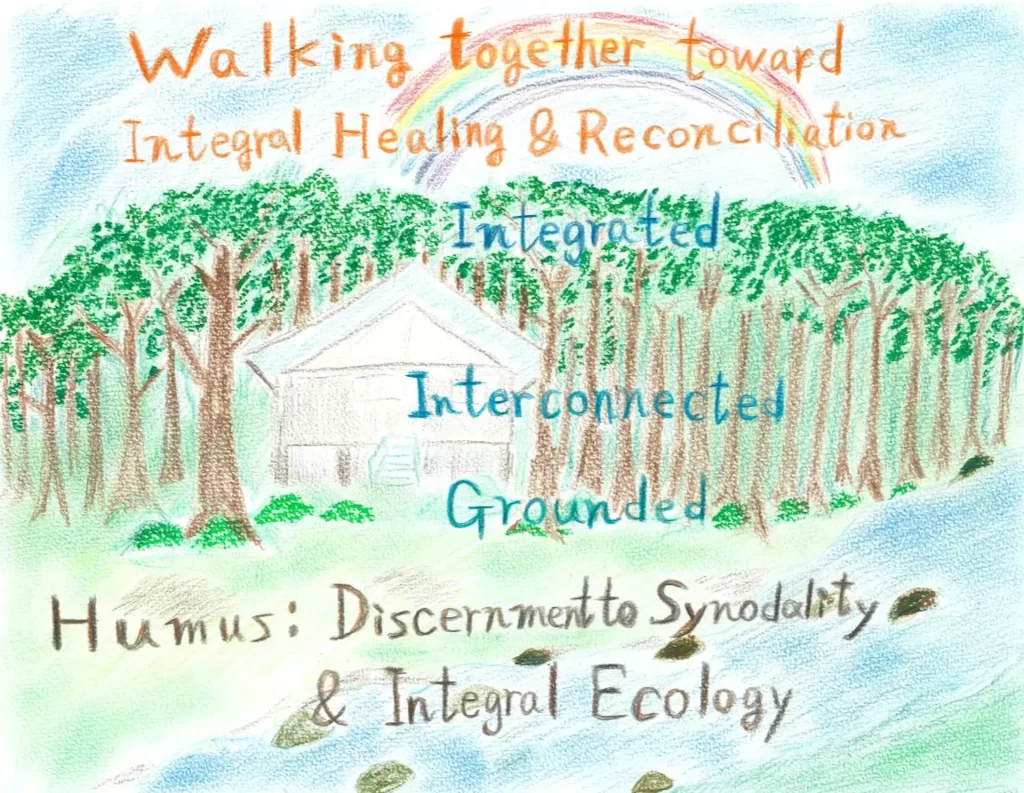
We chose Walking together towards integral healing and reconciliation as the HORIZON, or way that we seek to live the Universal Apostolic Preferences (UAPs) in the JCAP social apostolate today, within and across the Society of Jesus, and in partnership with others.
This choice flowed from our discussions about the violence, conflicts, polarisation, and suffering that are evident at so many levels—from the personal to the broader societal and international levels. The expression integral healing underscores the importance of healing occurring at these various levels, of these being integrated—thus being a form of healing in its own right.
We named synodality, integral ecology, and discernment as the three lenses that guide all our efforts. Synodality signifies our commitment to listening at all levels and walking together; integral ecology recognises the interconnectedness of all things; and discernment is the ongoing process permeating everything we do. Drawing on an ecological image, we see these three lenses as the humus which nourishes and sustains all our efforts.
We also identified three connected levels–grounded, interconnected, and integrated–at which the social apostolate operates; we affirmed the value and importance of the three levels and how each might be strengthened.
The grounded level refers to the various, diverse works that occur in provinces across JCAP. At its best, this work is characterised by being in relationship with and listening to people, communities, and place; humble; authentic; diverse (for example, in size, focus, and level of activity); and always attentive to the voice of the poor and of the earth in the local context.
These works are valued, in the first place, for responding to identified local needs. From an ecological perspective, we understand these works as living, evolving entities; they may require watering and feeding; they may be ready to be pruned or to give seed to something different or new. This highlights the value of reviewing them at the local level in order to discern their future, and the offer is there to call for assistance from the Core Group if that would be helpful.
Our intention to bring together members of the social apostolate in person annually and online quarterly speak to our desire to create a ‘home’ where they can connect, be encouraged, and support each other.
The interconnected level connects some grounded entities (and others beyond the Jesuit network as appropriate) into communities of learning and practice at the conference or inter-province level. These communities will have a leader, flexible structures shaped by members’ needs, and feed information and learnings back to the other levels to capture our contribution to the overarching horizon.
Some of these relationships/networks already exist, notably the Migrant and Refugee Network and the Ecology Network, which are endorsed within JCAP and contribute to the Global Ignatian Advocacy Network (GIAN) at the global level.
Other communities of learning and practice exist in bilateral or trilateral relationships and may evolved or dissolve as needed. A current example is the partnership between ESSC/JRS on climate-induced displacement. Additional possibilities include connecting entities working with people in prisons and transitioning back to community (eg Philippines, Thailand, Australia); disaster resilience/readiness (eg ESSC/Jesuit Social Services Australia); and ecological education across various provinces.
Beyond these, we will formalise a Formation and the Social Apostolate group; a COP 31 group; and contribute to cross sector collaboration through JCAP’s Extended Consult.
The integrated level refers to the universal level that connect all our efforts—feeding into SJES and the Society of Jesus’ mission more broadly in a dynamic, reciprocal, and ecological flow. Specifically, the grounded and the interconnected levels within JCAP contribute to the UAPs, GIAN, and specific priorities, such as climate justice and engagement with COP; in turn these nourish our grounded and interconnected activities. Taken as a whole, they point to our shared horizon: Walking together towards integral healing and reconciliation.