
In Korea, unpaid wages exceeded 2 trillion KRW (approximately USD 1.5 billion) in 2024 for the first time, with nearly 280,000 workers affected annually. Migrant workers are particularly vulnerable. According to the National Human Rights Commission, they suffer wage theft at more than three times the rate of Korean nationals, largely due to language barriers, limited access to legal remedies, and social marginalisation.
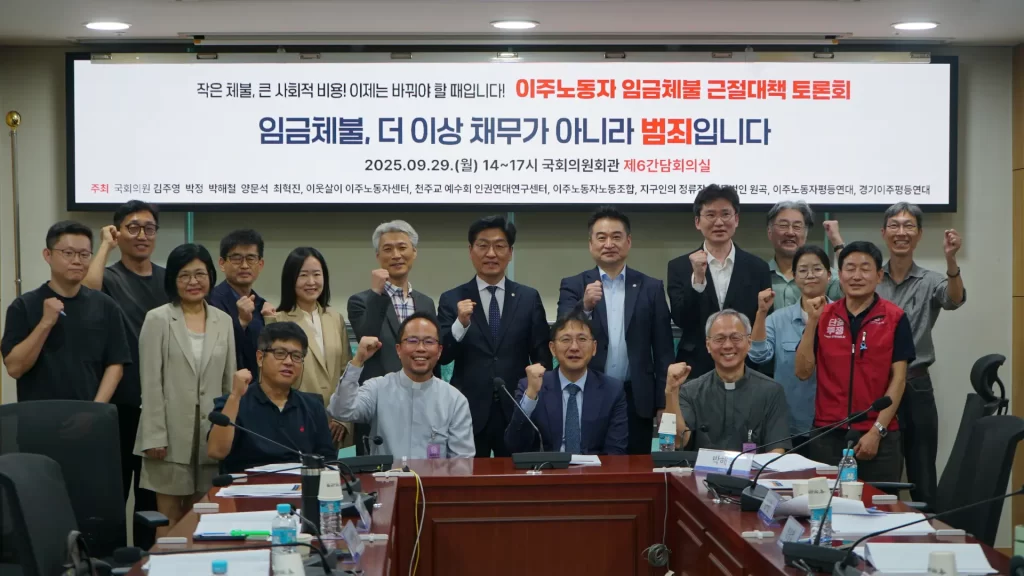
To help address the deepening crisis of wage theft, the Yiutsari Jesuit Center for Migrant Workers convened a public discussion on “Countermeasures for the Eradication of Wage Theft” at the Korean National Assembly in Seoul on 29 September.
The forum brought together five members of the National Assembly — including two from the Environment and Labour Committee — along with legal experts, migrant centre directors, and representatives from the Ministry of Employment and Labour, the Ministry of Justice, and the National Human Rights Commission of Korea’s Migrant Human Rights Team. A strong consensus emerged that wage theft is not merely a contractual issue but a systemic injustice that demands institutional reform.
I presented on the need to pass a Wage Theft Criminalisation Act.
At present, wage theft is addressed under the Labour Standards Act, which focuses on mediation and reconciliation rather than punitive sanctions. However, this approach is inadequate for intentional or repeated violations.
Wage claims should not be regarded as ordinary financial claims. They are essential means of guaranteeing the survival of workers and their families, forming a constitutional foundation for the right to work and the right to live with human dignity. Korean constitutional values, embodied in the Labour Standards Act, require us to recognise wage theft as a serious violation of human rights.
What is needed is a step-by-step roadmap, starting with differentiating the concept of wage violations under the Labour Standards into “simple delay” and “wage theft,” along with corresponding sentencing guidelines that reflect the seriousness of each offence.
In the long term, Korea should consider following the example of jurisdictions such as New York State and California, which have incorporated wage theft into their penal codes.
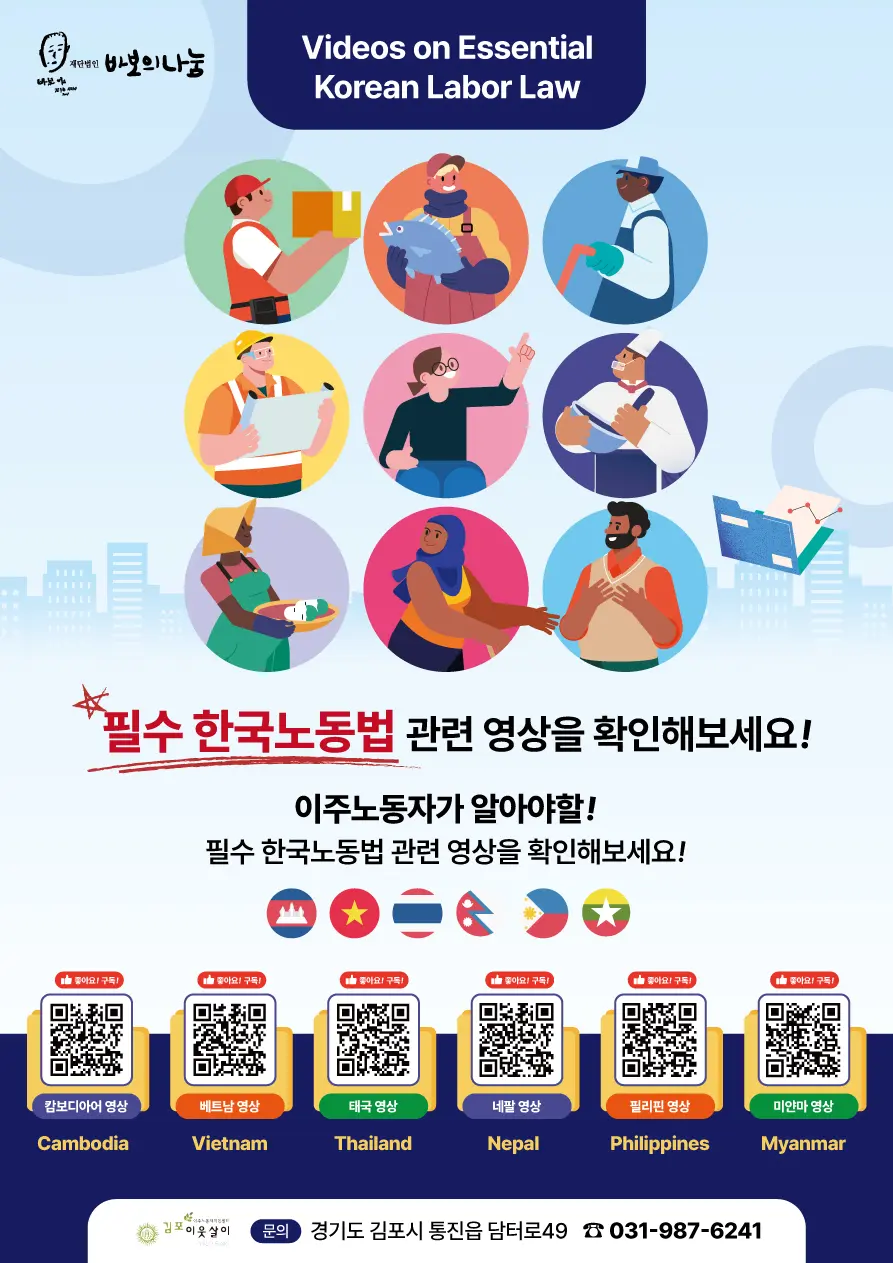
Poster for the Yiutsari Jesuit Center’s multilingual labour law video project launched in 2023
The Yiutsari Jesuit Center for Migrant Workers has long engaged in practical support for migrants. Since 2023, however, we have also undertaken advocacy-oriented initiatives, notably producing 15 five-minute educational video clips on essential Korean labour laws in workers’ native languages, starting with Cambodian, Vietnamese, and Thai. By 2025, the project expanded to include Myanmar, Filipino, and Nepali languages. These resources help migrant workers better understand and exercise their rights, strengthening their ability to claim what is justly theirs.
This movement also reflects a deeper faith tradition. In the parable of the vineyard workers (Matthew 20:1–16), the master insists on paying each labourer enough to live, reminding us that wages are about dignity, not merely calculation. Catholic social teaching affirms the same: as Rerum Novarum teaches, wages must sustain a worker and family. Laborem Exercens likewise states: just remuneration is the key to justice in work.
Legal reforms are much needed for a renewed moral vision of labour as a foundation of life and dignity. The long tradition of the Church teaches that withholding wages is not merely a technical violation but a wound against justice and humanity itself.